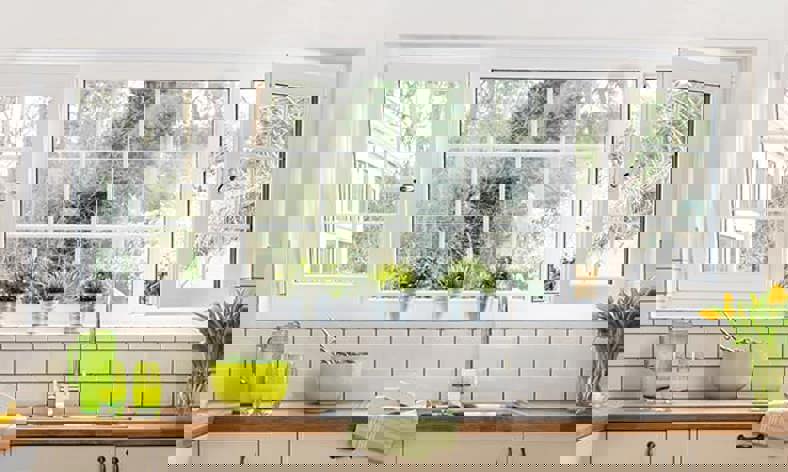
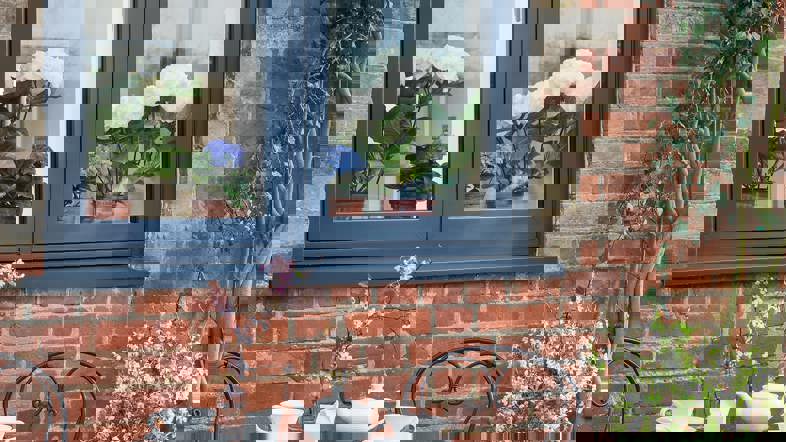
Standard casement windows
The standard casement window frame remains Britain's best-selling window design. Its enduring popularity is not difficult to explain. It is versatile enough to work on almost any style of property, from a 1930s semi to a new-build home, and it delivers strong performance across every measure that matters from thermal efficiency, weatherproofing and security.
Why homeowners choose standard casement windows
The lipped profile of a standard casement creates an inherently robust seal. When the sash is closed and locked, it presses tightly against the frame, forming a compression seal on all four sides. This is one of the reasons casement windows consistently score well for airtightness in independent testing.
Standard casements are also the more cost-effective option of the two styles, which makes them a practical choice when you are replacing windows across an entire property.
From a design perspective, standard casements offer considerable flexibility. They can be configured as side-hung, top-hung or fixed, and combined within a single frame to create bespoke arrangements. With Everest's range of colours and woodgrain foils, a standard casement can be tailored to suit virtually any property.
Flush casement windows
Flush casement windows have their roots in traditional British joinery. Before the mass adoption of uPVC in the 1980s and 1990s, most timber casement windows were built with a flush sash as standard. The lipped stormproof profile only became widespread with the arrival of early uPVC systems, which used the overlapping sash to compensate for less sophisticated sealing technology.
Modern flush casement windows represent a return to that original design philosophy, but built with the full benefit of twenty-first-century engineering. The result is a window that offers the sleek, elegant proportions of traditional timber joinery with the thermal performance, security and durability of a contemporary uPVC or aluminium frame.
Why homeowners choose flush casement windows
The clean lines and flat exterior profile of a flush casement give it an understated quality that works on both period and modern properties. For Victorian, Edwardian and inter-war homes, a flush casement closely replicates the proportions of the original timber windows, preserving the character of the building. For contemporary new builds and renovations, the minimalist profile complements current architectural trends towards clean, uncluttered facades.
This versatility is a major reason why flush casement windows have seen a sharp rise in popularity in recent years. Driven in part by homeowner demand for windows that combine period character with modern performance.
At Everest, our flush casement windows feature smooth welding technology, which creates an almost invisible joint at the frame corners. This eliminates the diagonal weld lines that are a tell-tale sign of uPVC manufacturing, giving the window a refined finish that closely mimics the mitred joints of traditional timber.